
When the Experience Is Stronger Than the Photograph
Why certain photographs feel stronger to us than they really are
A photograph can feel powerful in the moment, yet fall flat on the page.
It isn’t necessarily because the image is poor or that our visual instincts are lacking. Rather, it is because lived moments carry the emotional weight of our experience.
This can be hard to separate ourselves from, and thus getting objective feedback from others who have not shared these experiences with us (nor are attached to our images) is a crucial influencer of our growth photographically.
Photo critiques and reviews are an invaluable tool for photographers: from image selection, to printing, sequencing and presenting, the entire process forces us to confront our own work. That process alone can drive growth.

However, the feedback we get from impartial peers and experts allows us to detach from the experiences we had making the image, and more accurately calibrate toward what makes for a strong photograph.
Recently, I have done both an expert portfolio review and a peer photo critique that have helped me separate from my experiences and calibrate my own work.
“A Hot Chocolate Image”
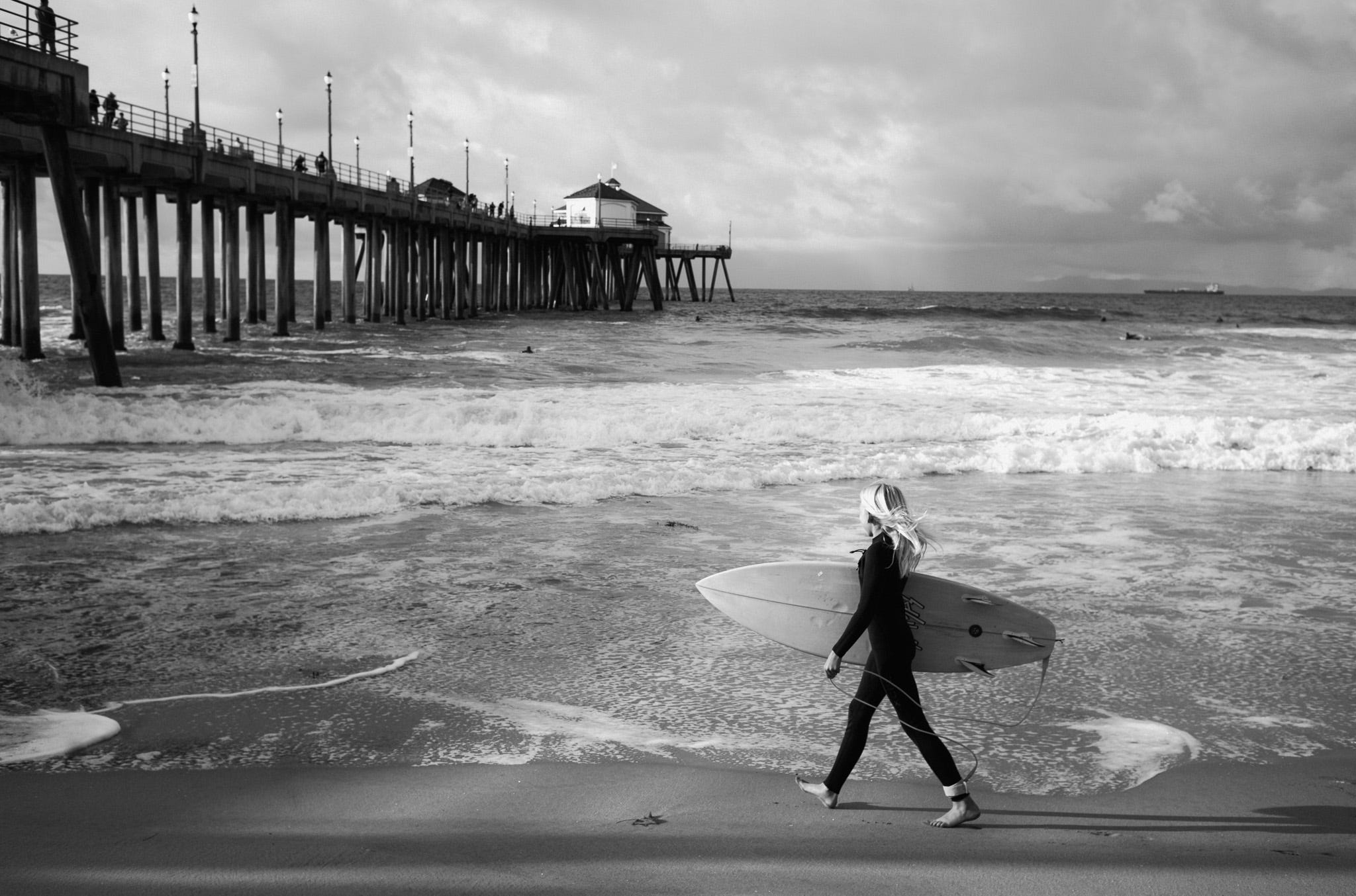
I originally brought this photograph (made in Huntington Beach, CA) to an expert portfolio review, along with around 10 other images. The review was a check in on my project, American Dream: A Portrait of America.
That day in California, I had just one hour to photograph, and what I was attempting to do was capture an essence of Southern California. And, when this girl came strutting by, surfboard tucked under arm, blond hair flowing in the sea breeze, I thought, now this is certainly one version of the American Dream… I backed up quickly in the soft sand, measured up the shot and released the shutter.
Peering at the LCD screen, I thought I had nailed Southern California with my very last image of the trip. And, upon loading it into LightRoom, I fell even more in love: the natural tones of the water; the moodiness of the storms in the distance juxtaposed with the tranquility of the girl; the boardwalk as a leading line out into the horizon…
And yet, the image fell flat with the reviewer. Peering at the print for a moment or two, he asked me what I saw in the moment, what the image conveyed to me, and I explained.
A polite, yet disheartening “Hmm” was what I got in response.
The reviewer went on to describe the photograph in a way that has truly stuck with me: a hot chocolate image, he called it. The kind of photograph that makes you feel good — because it is nice, and it is pretty. But what it is not: deep, nor strong.
In this case, the image is missing something. It is aesthetically pleasing, and it does fit the theme of the project. But there is no tension or friction; there is no connection nor emotional weight; there is no story being told, nor questions being asked.
And, when I stacked the image alongside the rest of my work, I had to agree.
Where my other photographs focused on the human in front of the camera, this one — once the personal and experiential ties were removed — struck me more as a fine art landscape image. Something that I would be happy to put up on my own wall, but not select as a part of a meaningful project.
“An anonymous photograph”
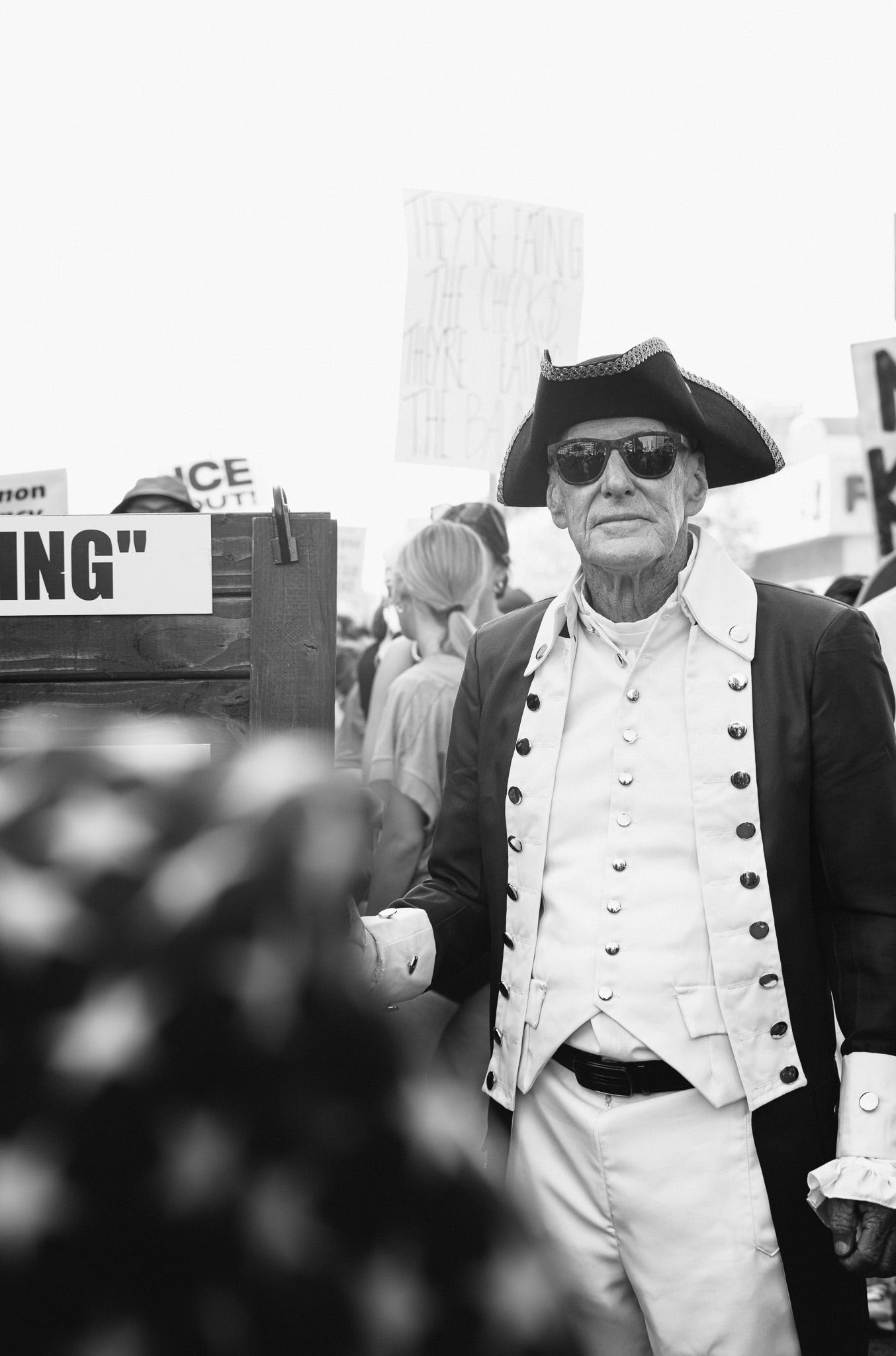
Nothing gets you more attached to a photograph quite like an emotional or stressful experience. Protest photography has started to prove this point to me, as it feels like nearly every image that I make at a political rally seems to compel me to keep it around.
During a recent No Kings rally in Downtown Phoenix, AZ, I saw this gentleman in character and decided to do something a bit different than my usual. Popping off the wide 35mm lens that stays glued to my Leica, I grabbed a 75mm lens from my bag and mounted it to the camera.
Stepping back and crouching down into the crowd, I worked to gain focus while putting a foregrounding object with stars and stripes just to the left of our subject.
My attachment to this photograph came not just from being in the middle of a jostling crowd, but also from the experience of intentionally making photographic decisions in real-time. Knowing the lengths I went through to make this composition work in a chaotic environment (and seeing it actually come out the way I envisioned it) brought me a whole lot of satisfaction.
What it didn’t do, however, was make a photograph that matched the rest of the work I brought for a recent peer review:
“If I was going to leave out one image, it would be that one. The guy in the sunglasses. It’s just… anonymous.” Followed by a room full of agreement.
With further elaboration later on, I understood the sentiment: the image was fine.
But, fine is not strong.
And, when surrounded by other photographs that either demonstrate connection, provoke inquiry, begin to tell a story, or truly grasp a viewer’s attention through complexity or relationships, it is easy to point out what this image lacks.
And that was the realization: effort and intentionality do not automatically produce depth. They may bring us closer to the moment, but they don’t necessarily bring the viewer any closer.
While this image may not resonate with everyone, it still matters. It taught me something and was an invaluable rep that put artistic vision and execution under time pressure.
“Just somebody walking by a flag”
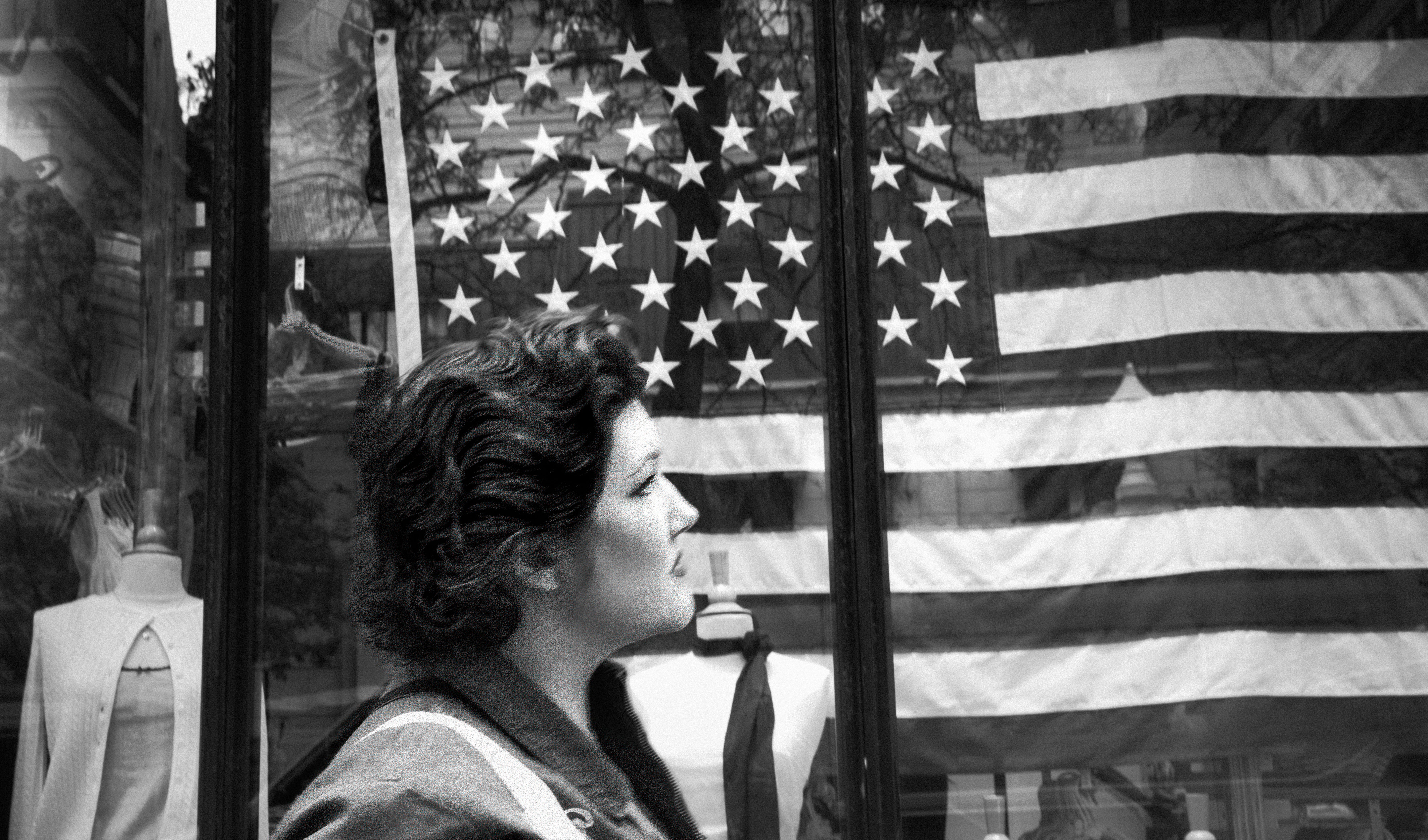
A second image from the set of ten that I brought to the recent peer review, this photograph was taken recently in Chicago, IL.
Much like my other trips, I rarely get more than a few hours to photograph, so I was quite excited to make an image in a new city that had the potential to contribute to a broader body of work — in this case, American Dream. And, I happened to wait a decent amount of time for the '“right” person to walk in front of this storefront.
My hope was to get somebody with a bit of that 1950s feel — just enough to make you call back to a different era, but not enough for you to mistake when the photograph was made. And, I thought I had gotten that with the image. And, given its obvious symbolic nature, I became attached to the idea of it being a strong image.
However, the peer critque revealed that it was one of the weaker photos of the lot. The line that punched the hardest: “It is just a person walking in front of flag.”
And, honestly… they were right.
The image lacks tension or emotional weight; there is no real line of inquiry beneath the symbolism itself. And the symbolism is doing far too much of the work — and in a way that feels obvious, not revealing.
What’s more, I had 2-3 other images with either flags or patriotic symbols in them. Sure, American Dream is a project aiming to provide national commentary — what does it mean to be human in America today? However, not every photograph needs to explictly announce that it is “about America” by punctuating the frame with a flag.
Thus, much like the images prior, this is again not necessarily an example of a poor image, but rather of an image that is, in fact, useful — just not fully realized.
Oftentimes, the hardest images for us to evaluate come from the experiences that we lived in the most. Whether it be the weight or significance of the moment, the lengths to which we went to make the image, or the diligence we demonstrated in crafting the composition.
It is this attachment that can make images so special to us. And yet, it can also cloud our judgment as to which photograph best represents a moment and resonates with others.
This is what makes critique so invaluable. It is not necessarily because others will always be right, nor because we get feedback that is always worth following, but because it helps separate the emotional experience of making an image from the actual strength of the photograph itself.
That detachment of self from image can often be uncomfortable — maybe even painful. But it is a vital part of our growth as artists.
Especially if our intention goes beyond simply collecting individual images that we like, and instead seek to build a body of work that stands on its own.
Found this article fascinating and it’s exactly right with regards to emotion. Some of my photos which I’ve loved are because of the moment, more than a perfect picture. I’ve felt quite offended with a judge’s comment but they were right. It meant did more to me. However one image which I loved, I knew wasn’t perfect but it was a grab shot that I loved. And so did the judge!
Hot chocolate photos: Love it. I've made plenty of them. They're frustrating because they're 80%-90% of the way to working. John Loengard, former picture editor at LIFE magazine, suggested that the solution to these was a dash of peculiarity.
“Unless there is something a little incomplete and a little strange, it will simply look like a copy of something pretty,” Loengard said. “If there is nothing peculiar, don’t take your cameras out. You don’t need to see a two-headed cow; the peculiarity may be something small, only part of a picture… However, you have to be able to say it is peculiar, not dramatic, or beautiful or interesting or historic, although it might bar those things too. A photograph, I realized, needs a dash of peculiarity the way a Bloody Mary needs a bit of Tabasco.” That's from his book, Pictures Under Discussion - I recommend it;